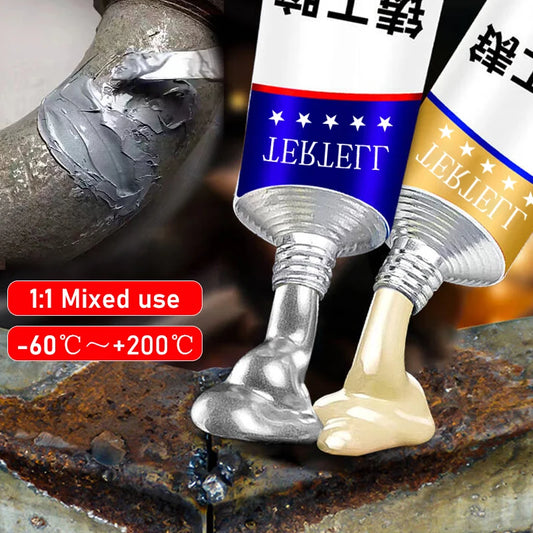
Two-part metal repair
For the cracked casting nobody wants to weld.
Some repairs are too small for a welder and too structural for superglue: a hairline crack in a cast-iron bracket, a pinhole weeping out of a steel pipe, a stripped thread in an aluminium housing, a chip out of a pump body. This is a two-part epoxy filled with metal powder — you mix it, pack it into the damage, and leave it overnight. Once it cures it can be drilled, filed, sanded and painted like the metal around it.

How it works
Grey plus beige, one to one
Tube A is the grey, metal-filled resin. Tube B is the beige hardener. Neither does anything on its own — the reaction only starts when they meet, which is why there is no rush to open the tube and no shelf life burning down once you have.
Squeeze equal amounts of each, stir until the colour is one uniform grey with no streaks, and use it. Getting that ratio roughly right matters more than anything else you do: a mix that is heavy on one side stays soft and never reaches full hardness.
Four steps
Mix, pack, wait a day
1. Squeeze A and B out 1:1.
2. Stir until the colour is uniform.
3. Press it into the damage, slightly proud of the surface.
4. Leave it 24 hours before you load it, machine it or paint it.
The single thing that decides whether a repair holds is the surface underneath it. Grind or sand back to bright metal, take the shine off so there is a key for the epoxy to bite into, and wipe off every trace of oil. Epoxy sticks to clean, rough metal and slides off greasy, polished metal.
Two formats, and they are not the same thing
Tubes, or a cartridge

Tubes — 20 g, 50 g, 70 g, 100 g. Two separate tubes you mix by hand. Cheapest per gram, and you decide exactly how much to mix, so a 2 g repair costs you 2 g. The 50 g, 70 g and 100 g sizes come in a box with a black spatula. The 20 g comes either boxed with a brush, or bare — two tubes and nothing else, which is the cheapest way onto this page.

Cartridge — 50 ml, 100 ml. One dual-barrel cartridge that meters both parts for you and mixes them inside the disposable nozzle as they come out. Nothing to measure, nothing to stir, no wrong ratio. Ships with mixer nozzles, a spatula and an abrasive pad. A cartridge gun is not included — the plunger can be pushed by hand for small jobs, but a standard 50 ml two-component gun makes it far easier.
The gram figures are the combined weight of both parts. A “50 g” size is roughly 25 g of A and 25 g of B, not 50 g of each.
Which size
Buy for the job, not for the shelf
| Size |
Suits |
| 20 g tubes — bare |
The cheapest way to try it. Two tubes, no box, no brush — one small repair. |
| 20 g tubes — box |
One repair, with the box and brush. A cracked bracket, a leaking joint, a stripped thread. |
| 50 g tubes |
The sensible drawer size. Several small repairs over a year or two. |
| 70 g / 100 g tubes |
Filling volume — a chipped casting, a corroded section, a hole you need to rebuild and machine back. |
| 50 ml cartridge |
When you would rather not mix by hand, or the repair needs to be right first time. |
| 100 ml cartridge |
Repeat work — a workshop, a fleet, a maintenance round. |
| 100 g tubes + 100 ml cartridge |
Both formats together. Hand-mix small amounts from the tubes, use the cartridge when the job is bigger. |
Once it is hard
You can machine it like metal
This is what separates a metal-filled epoxy from an ordinary glue. After a full cure the repair can be drilled, tapped, filed, sanded and painted. You can rebuild a chipped edge slightly proud, then take it back down to the original profile.
The manufacturer rates it for a service range of −60 °C to +200 °C and describes it as resistant to water, oil and corrosion. We are passing on their figures — we have not tested them ourselves, and we have not seen a published tensile or shear strength for this product, so we are not going to quote one.
Before you buy
Where this is the wrong answer
It is not a substitute for a weld on anything load-bearing. A trailer hitch, a suspension component, a ladder, a lifting eye, a pressure vessel — take those to someone with a welder. Epoxy repairs belong on housings, castings, brackets, covers, threads, leaks and cosmetic damage.
It is not certified for anything that touches food or drinking water. No such approval is published for it, so we will not imply one.
It needs a clean, roughened surface. On smooth, painted, plated or oily metal it will let go, and that is a preparation failure rather than a product failure.
The tubes are labelled in Chinese. This is a factory product from an overseas supplier, printed for its home market. Everything you need to use it is on this page; there is no English leaflet in the box.
Specifications
What the manufacturer actually states
| Type |
Two-part epoxy adhesive filled with metal powder (“AB glue”, casting/foundry repair type) |
| Mix ratio |
1 : 1 — by hand for the tubes, automatically in the nozzle for the cartridge |
| Cure time |
24 hours before loading, machining or painting |
| Working time |
Not published by the manufacturer. Mix small batches and expect it to start stiffening within minutes. |
| Service range |
−60 °C to +200 °C (−76 °F to 392 °F), manufacturer’s figure |
| Resistance |
Water, oil and corrosion, per the manufacturer. No immersion rating or IP figure is published. |
| After curing |
Can be drilled, tapped, milled, sanded, polished and painted |
| Cured colour |
Metallic grey |
| Sizes |
20 g · 50 g · 70 g · 100 g tubes · 50 ml · 100 ml cartridges · 100 g + 100 ml together. Gram figures are A and B combined. |
| In the box |
Tubes 50 g and up: A tube, B tube, card box, black spatula. The 20 g comes boxed with a brush, or bare as the two tubes only. Cartridges: cartridge, static mixer nozzles, spatula, abrasive pad — no gun. |
| Not included |
Cartridge gun · gloves · English-language leaflet |
| Brand |
Factory product — tubes marked TERTELL, cartridges marked eoopee. Sold under our own listing. |
Good to know
Questions people ask
Will it hold a stripped bolt thread?
For a light-duty fixing, yes — this is one of the jobs metal-filled epoxy is genuinely good at. Clean the hole, fill it, let it cure fully, then drill and tap fresh. For a fastener carrying real load, use a thread insert instead.
Can I stop a leak with it?
On a low-pressure pipe or a weeping joint, once the surface is dry and abraded, this is a normal use for it — the manufacturer’s own photos show exactly that. It will not hold on a wet, actively spraying leak: shut the line off, dry it, then repair.
How long do I actually have once it is mixed?
The manufacturer does not publish a pot life, so we will not invent one. Treat it like any filled epoxy: mix what you can place in a couple of minutes, and mix again rather than trying to stretch a batch that has started to stiffen.
What is the difference between the 20 g boxed and the 20 g bare?
The glue is the same. The boxed one comes in a card box with a brush; the bare one is the two tubes on their own. If you already have something to stir and spread with, the bare option is the cheaper way in.
Does it work on anything other than metal?
It is sold as a metal repair adhesive and that is what we can speak to. Epoxies of this type are generally used on ceramic, stone and rigid plastics too, but no compatibility list is published for this one, so test on a hidden area first if the substrate is not metal.
Do I need a gun for the cartridge?
Not strictly — the plunger can be pushed by hand for a small amount. But a standard 50 ml 1:1 two-component gun costs very little and makes the cartridge far easier to control. One is not included.
What happens if I get the ratio wrong?
It stays soft or tacky and never reaches full strength — and there is no fixing it afterwards. This is the one place to be careful with the tube versions. If accuracy worries you, the cartridge meters both parts for you.
Is it safe on skin?
Uncured epoxy resin and hardener irritate skin and can sensitise you with repeated exposure. Wear gloves, work with some ventilation, and keep it off your hands. Once fully cured it is inert.
How should I store it?
Caps on, tubes separate, somewhere cool and dry. The two parts do nothing until they meet, so an unopened set keeps well — but a cartridge with a used nozzle left on it will set solid inside the nozzle. Pull the nozzle off after use and cap the cartridge.
Shipping & returns
Delivery in 7–15 business days from the time you order — that window already includes the 1–2 business days we take to process. Tracking is emailed as soon as the carrier scans the parcel. Shipping & Delivery.
30-day returns. Items must be unused and in their original packaging — an opened tube or a used cartridge cannot be returned. Email support@nexuratool.com to start a return.
Nexura Tools
Tools, home gear and gadgets — chosen for specs we can verify.