The cut that sits flat
For the trim a big pair of cutters ruins.
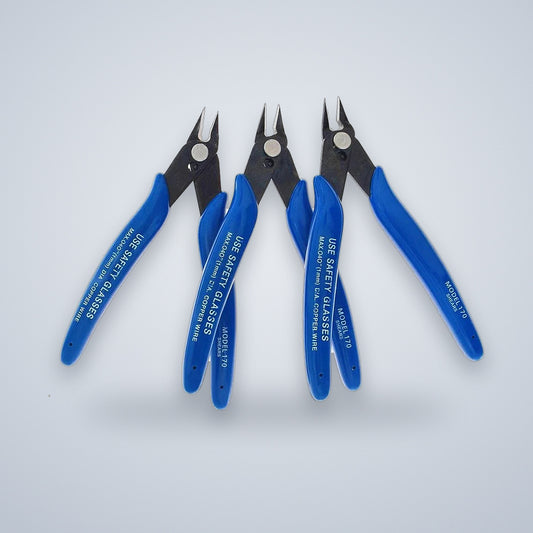
Side cutters built for small work: component legs on a populated board, a zip tie flush against a loom, the support scars on a fresh 3D print, a sprue gate on a model kit. One jaw face is ground nearly flat, so the cut lands close to the surface instead of leaving a stub you have to go back and file.

SK5 carbon steel
Hardened jaws, HRC 50 ±3
Max 1 mm copper
The limit moulded on the handle
Spring return
Opens itself between cuts
132 mm long
Thin enough for a shirt pocket
What it is for
Small, soft and close to the surface
The head is 32 mm across with an 18 mm jaw and a 6 mm cutting edge — narrow enough to get between a capacitor and the header next to it, which is the whole reason a shop keeps a pair of these next to the iron rather than reaching for lineman's pliers.
Hobby benches use them the same way: sprue gates on a model kit, brim and support scars on a print, thread and beading wire, the tag end of a cable tie that would otherwise catch a knuckle every time you reach past it.
Read this before anything else
One millimetre of copper. That is the number.
The maker moulds the rating straight into the handle: MAX .040" (1 mm) DIA. COPPER WIRE. That is the honest working limit of a hardened, thin-ground jaw, and it is the line between a tool that stays sharp for years and one you chip on the first job.
Inside that line: copper and tinned copper, component legs, plastic sprue and supports, cable ties, thread, soft beading wire. Outside it: steel or piano wire, nails, screws, spring steel, hardened anything. A cutter ground this fine does not argue with hard metal — it takes a notch out of the edge, and the notch never comes back.
The other line moulded on the handle is USE SAFETY GLASSES, and it is there for a reason. Offcuts leave a spring-loaded jaw fast and they leave it sideways. Cup your free hand over the cut or wear glasses — cheap habit, cheap insurance.
Four pack sizes
Buy one, or stop hunting for one
These are consumables more than heirlooms. A bench that does daily trimming goes through edges; a repair shop with three stations wants three pairs so nobody walks. The larger packs exist for that, not as a novelty — and they cost less per pair.

1 pair
One pair for the drawer, or a try-before-you-commit.

5 pairs
A home bench, a print farm, or one per toolbox across a small crew.

10 pairs
Workshop stock. Put a fresh pair out when an edge goes and bin the old one.

20 pairs
Classroom, makerspace or production line — the cheapest way per pair.
In the hand
The spring does the boring half of the work
A spring between the handles pops the jaws open after every cut, so trimming thirty legs on a board is thirty squeezes rather than sixty movements. It is the difference between a tool you can use for an hour and one that makes your hand ache in ten minutes.
The handles are TPR over the steel — soft enough to grip without gloves, thin enough that the pair still disappears into a shirt pocket. There is a lanyard hole in each handle tip if your bench has a tether rule.
Straight answers
Three things we would rather you knew now
This is a cutter, not a stripper or a crimper. Listings for this pattern of plier often pile those words into the title. It has no stripping notches and no crimping die — it cuts, and that is all it does.
Soft metal only. One millimetre of copper is the rating. Steel wire, nails and spring steel will notch the edge, and a notched flush cutter leaves a ragged stub on every cut afterwards.
It is a consumable at this price. SK5 at HRC 50 ±3 holds an edge well for soft work, but it is not a $40 precision cutter with induction-hardened tips. Treat a pair as something you replace, not something you send out for sharpening — which is exactly why the multipacks are here.
The specifics
Sizes and materials
Overall length
132 mm on the maker's drawing; their written spec sheet says 125 mm. Either way it is a five-inch class cutter.
Head
32 mm long, 18 mm jaw, 6 mm cutting edge
Handles
80 mm, TPR over steel, lanyard hole in each tip
Jaw material
SK5 carbon steel, hardened, knife-edge ground
Edge hardness
HRC 50 ±3, as stated by the maker
Cutting capacity
1 mm (0.040 in) diameter copper wire — the figure moulded on the handle
Action
Spring return, opens on release
Colour
Blue handles, black jaws
In the box
1, 5, 10 or 20 pairs of cutters — whichever pack you choose. No case, no other tools.
Questions people ask
Before you order
Will it cut steel wire, guitar strings or nails?
No, and trying it once is usually enough to ruin the edge. The rating is 1 mm of copper. For hard wire you want a dedicated hard-wire cutter with induction-hardened jaws, which is a different and heavier tool.
Does it cut truly flush?
One face of the jaws is ground nearly flat, so with that face against the board the cut sits very close to the surface — close enough that most people stop reaching for a file. It is a near-flush grind at this price, not a certified flush cutter.
Can I use it on 3D prints?
Yes — this pattern is a standard on print benches for supports, brim and stringing in PLA and PETG. Take support material off in small bites rather than levering with the jaws; the tool is ground to cut, not to pry.
Is it ESD safe?
No. The handles are ordinary TPR, not a dissipative compound, and nothing here is rated for ESD work. If you are handling static-sensitive parts, this is not the pair to use.
Are the handles insulated for live work?
No. The TPR is there for grip and comfort — it carries no VDE or 1000 V rating. Do not use these on live circuits.
Which pack should I buy?
One pair if it is for a drawer. Five if you trim most days or want one per toolbox. Ten or twenty if you are stocking a workshop, a classroom or a line, where the point is that a fresh pair is always within reach.
Can the jaws be sharpened?
In principle, on a fine stone, holding the original bevel. In practice almost nobody does it at this price — the grind is thin and easy to ruin, and a new pair costs less than the time. Keep the edge instead: soft metal only, no prying.
How do I look after them?
Wipe the jaws dry after damp work and put a trace of light oil on the pivot every few months. Carbon steel rusts if you leave it wet; that is the only maintenance these ask for.
Shipping & returns
Delivery in 7–15 business days from the time you order — that window already includes the 1–2 business days we take to process. Tracking is emailed as soon as the carrier scans the parcel. Shipping & Delivery.
30-day returns. Items must be unused and in their original packaging. Email support@nexuratool.com to start a return.
Nexura Tools
Tools for repair, maintenance and the jobs in between — chosen for specs we can verify.