
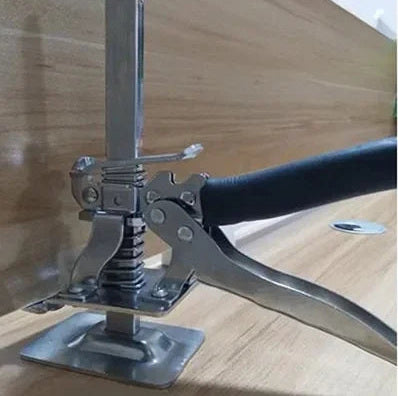
Floorboards and panels
Lift the edge of a board clear, slide the next one under it, let the ratchet hold while you tap it home. Beats a pry bar and a knee, and it does not mark the face.


Lifts to 4 in · 18.5 cm tall · steel
Slide it under the edge, squeeze the lever, and the board comes up a notch at a time and stays there. Up to 4 inches of lift, with both of your hands free for the shim, the screw or the pencil line. Read this first: it is a positioning tool, not a jack stand. Nothing holding a load like this should ever have a person under it.
Most of this work takes two — one at each end of a board or a cabinet, so the thing comes up level instead of pivoting. A 2-pack is two complete lifters.
Turn it over
Drag to turn the model while it works. The rail and the steel foot stay put; the body with the pressing plate walks up the rail a notch at a time, which is why the tool is the same height whether it is up or down.
This is a 3D model we built in code from the maker's own photographs, to the dimensions it publishes. It is not a photograph of the item, and the motion is our illustration of how the mechanism works, not a measurement of it. The photographs in the gallery above are the maker's own.
The third hand you keep asking for
A steel lever jack that creeps a board, a door or a cabinet up to four inches off the floor and holds it there. Squeeze the handle a few times, let the ratchet take the weight, and get on with the shim and the screw.

What it is made of
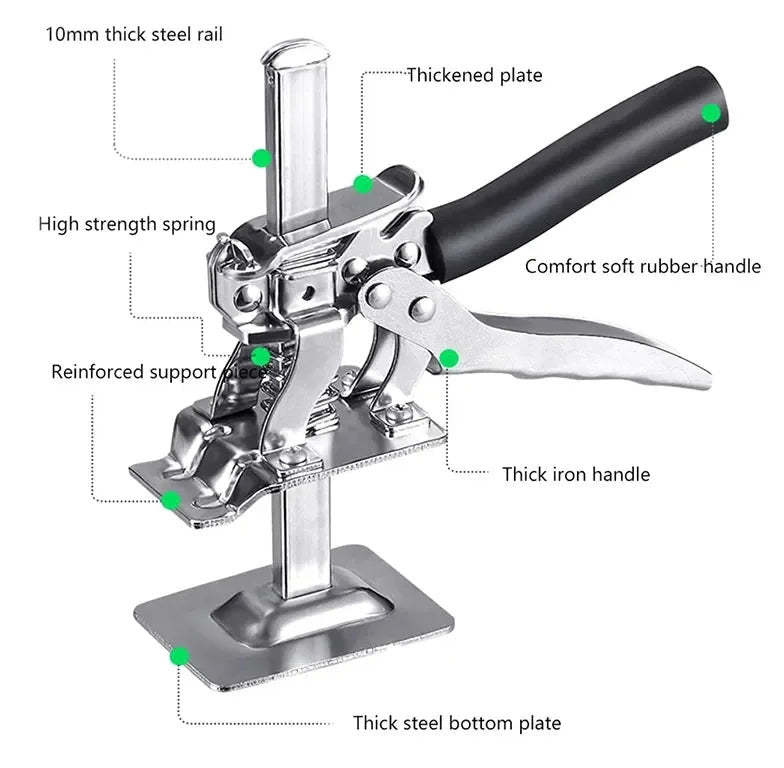
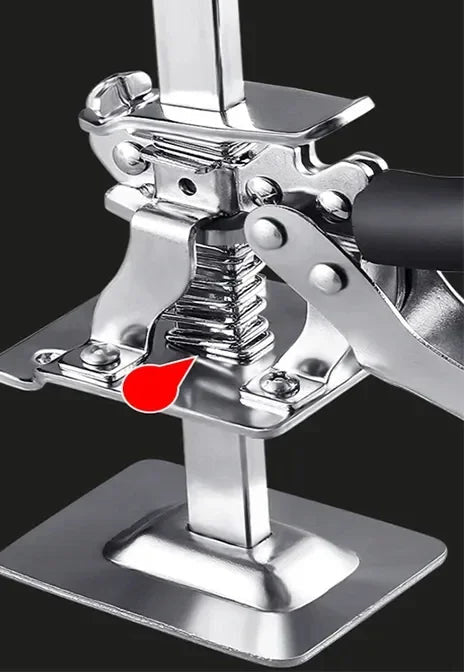
The maker names the parts in its own diagram: a thick steel rail, a thickened top plate, a high-strength compression spring, a reinforced support, a thick steel base plate and a soft rubber handle. The body climbs the rail; the rail does not move.
Each squeeze walks the body one notch up the rail. Let go and the ratchet holds where it got to, so you are not fighting the weight while you reach for a shim.
The compression spring resets the lever between strokes and keeps the foot plate pressed down, which is what stops the whole thing skating across a smooth floor.
The thickened plate on top of the body is the face that meets your board. The rail carries on above it as the guide, so keep the load on the plate and not balanced on the rail's tip.
The names above are the maker's. We have not taken one apart to confirm the grades of steel behind them.
The specifics
This is a load-bearing tool, so the figures matter more than usual. Every one below is the maker's own, and none of them comes with a test standard — read the last two rows before you plan a job around it.
maximum lift
10 cm. The smallest step up is about 0.5 cm, roughly 1/5 in.
stated load
About 265 lb. The maker's number, with no test standard named behind it.
height
About 7.2 in, and it stays that height whether the body is up or down.
foot plate
About 3.1 × 2.3 in. The maker's spec block prints 76 mm for the same plate.
rail thickness
The maker's own label on its parts diagram for the vertical rail.
per pack
Two is the usual number for a board, one at each end.
* Marked figures are the maker's own and are not measured or tested by us.

A steel lever jack with a ratcheting body that climbs a fixed rail. It raises and holds; it does not support anything you get underneath.
One lifter per pack. The maker lists nothing else — no case, no pads, no spare spring.
Where it earns its keep
Three of them from the maker's own photographs. The pattern is the same every time: something heavy has to sit a few millimeters higher than it is now, and stay there while you fix it.
Lift the edge of a board clear, slide the next one under it, let the ratchet hold while you tap it home. Beats a pry bar and a knee, and it does not mark the face.
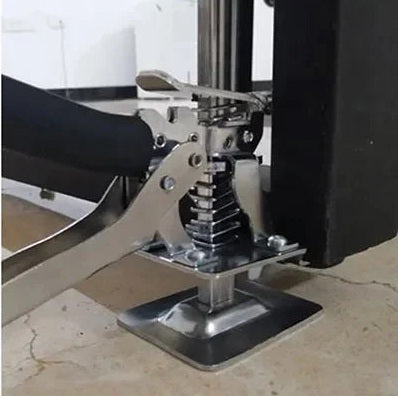
Press a length of trim up tight against the line and keep it there with both hands free for the nail gun. Two of them hold a long run flat along the whole wall.
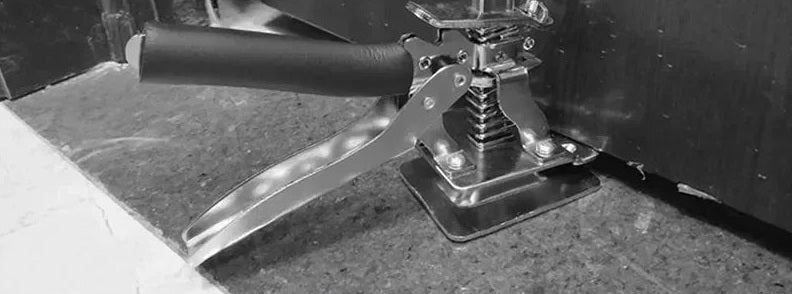
Raise a counter or a carcass the few millimeters it needs to come level, then slide a packer in. One at each end means it goes up square instead of pivoting on a corner.
Living with it
The base plate is about 8 × 6 cm, so it wants a firm floor rather than carpet or a soft board. Slide the top plate under the edge you are lifting and square the rail up.
Each stroke walks the body one step up the rail. Watch the load rather than the tool: a few millimeters at a time is the point, and 4 inches is the end of the travel.
Put a packer under the load, release the catch, and lower the weight onto the packer rather than leaving the jack holding it. Keep a hand on the load as it comes down.
That is the whole routine. The one rule worth repeating: a ratchet that holds a load is not the same as a stand that is safe to work under. Keep your hands and your head out from under anything this is carrying, and put the weight back down on something solid before you crawl in.
Compared with the usual options
Three ways to get a heavy edge off the floor. Read the bottom row first — it is the one that decides whether this tool is the right answer at all.
| Feature | Nexura board lifter | A pry bar and packers | A second pair of hands |
|---|---|---|---|
| Holds the load on its own | ✓ on the ratchet | ✗ you hold it | |
| Leaves both your hands free | |||
| Lifts in small, repeatable steps | ✓ about 0.5 cm a notch | However far you lean | Depends who is helping |
| Fits in a tool bag | ✓ 18.5 cm, metal | ||
| Marks the work | Steel plate — pad it on a finished face | Often | |
| Works alone at 7am | |||
| Height it will reach | 4 in, and no further | A few inches | As high as you can both lift |
| Safe to work underneath | ✗ never |
Compared by type, not by brand. Nothing in this table is a safety rating; no test report is published for this tool.
Free shipping on orders of $49 or more. Below that, standard shipping is a flat $4.95 to any of the 50 US states. Delivery takes 7–15 business days from the time you order, and that window already includes the 1–2 business days we take to process. Shipping & Delivery.
30-day returns. Items must be unused and in their original packaging. Email support@nexuratool.com with your order number to start a return. Returns & Refunds.
30 days from delivery. Email support@nexuratool.com with your order number and what you want to return. We reply with a return address — do not send anything back before you have it, or we cannot match the parcel to your order.
What we can take back: unused items in their original, undamaged packaging. Adhesives, sealants and lubricants cannot be returned once opened; the same goes for any item with a broken safety seal. That is a safety and hazardous-goods rule, not a preference.
Who pays: return shipping is paid by you, except when the item arrived damaged, faulty or was not what you ordered — then we cover it and refund the original shipping too.
Refunds go back to the original payment method within 5 business days of the return reaching us. Full returns policy.
QUESTIONS PEOPLE ASK
4 in of lift · 18.5 cm tall · steel
One lifter or two, each a complete steel jack. It raises an edge up to four inches and holds it there — and it is not a jack stand, so keep yourself out from under the load. Free US shipping from $49, and 30 days to return unused items.
