Stop using your finger
The bead looks amateur because the tool was a fingertip.
Silicone goes down fine. It is the ten seconds afterwards that decide whether the joint looks like a trade finished it. This is the shaped polyurethane blade people use for those ten seconds — one pass, an even concave bead, no smear on the tile and no silicone up to your second knuckle.

Polyurethane
Flexes to the joint, wipes clean
9.5 × 6.5 cm
Fits the palm, not a toolbox
Re-cuttable edge
Scissors give you a fresh corner
Tile, wood, brick
Internal corners and perimeters
What it actually does
One pass, one profile, every joint the same
The working corner is a fixed radius. Drag it along a fresh bead and it does three things at once: presses the sealant into the joint so it actually bonds to both faces, scrapes the surplus off ahead of the blade, and leaves a concave face that sheds water instead of holding it.
A finger cannot hold one radius for three metres, and it stops being clean after the first corner. That is the whole argument for this tool — consistency, not effort.
The part nobody tells you
When the corner nicks, cut a new one
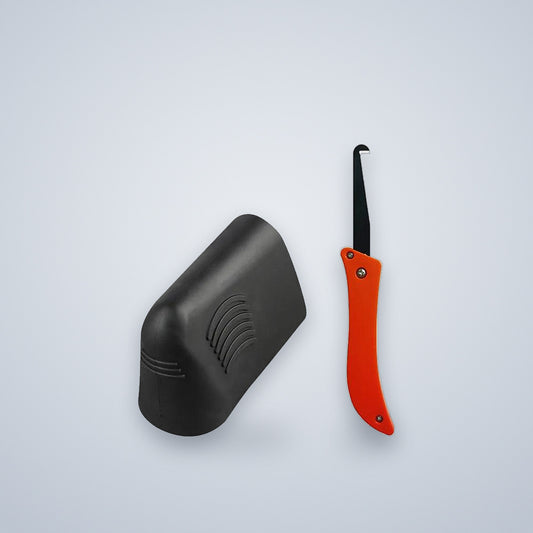
Look at the face of the blade and you will see a set of moulded arcs. They are not decoration — they are cutting guides. Catch the corner on a tile edge and tear it, and the tool is not finished: take scissors, cut along the next arc, trim the edge clean, and you have a fresh radius.
That is why it is polyurethane and not metal. A steel profile is ruined the day you chip it. This one is designed to be re-shaped several times before it is genuinely used up, which is also why buying a spare is cheaper than being careful.
The arcs sit at slightly different radii, so a re-cut also lets you go a size up if you are working a wider joint than the one you bought it for.
Two options
With or without the seam knife
New work only needs the finisher. Anything you are re-doing needs the old bead out first, and that is a different job — one a utility knife does badly and a hooked blade does in one pull.

Finisher only
The blade on its own. Right choice if the joint is bare — new tile, a fresh bath, a skirting run that has never been sealed.

Finisher + seam knife
Adds a 21 cm knife with a hooked tip that runs down the joint and lifts the old bead out in one piece. The half of the job that actually takes the time.
Straight answers
Three things we would rather you knew now
No sealant is included. This shapes a bead; it does not supply one. You still need your own silicone or polyurethane and a gun to lay it.
Work while the sealant is wet. The window is a few minutes — tool the bead straight after you lay it. Once a skin forms, dragging the blade tears the surface rather than smoothing it, and no tool fixes that.
It is a consumable, not an heirloom. Polyurethane at this price is meant to be re-cut and eventually replaced. That is a design choice, not a defect — buy the spare rather than nursing a torn corner through a job.
The specifics
Sizes and materials
Finisher size
9.5 × 6.5 cm (3.7 × 2.6 in)
Finisher material
Polyurethane, black
Cutting guides
Moulded arcs on the blade face — trim to a fresh radius with scissors
Seam knife
About 21 cm overall, hooked blade, moulded handle — in the set option only
Surfaces
Ceramic tile, wood, brick; internal corners and perimeter joints
Jobs
Pointing and caulking — smoothing a laid bead, not applying it
In the box
One finisher — or one finisher and one seam knife, depending on the option. No sealant.
Questions people ask
Before you order
Does it come with silicone?
No. You bring your own sealant and gun. This is the tool that shapes the bead after it is laid.
Silicone, acrylic or polyurethane sealant?
All three, as long as they are still wet. The blade does not care what the bead is made of; it cares whether a skin has formed.
Do I still need to wet the joint or use soapy water?
Usually not — a clean dry blade drags well on fresh sealant. If it is sticking, a light mist of soapy water on the blade helps, but keep it off the joint faces: too much and you interfere with adhesion.
How many joint widths does it do?
One radius at a time — the corner you are currently using. The arcs let you cut to a different radius when that corner wears, so over its life it covers a range rather than a single size.
How do I clean it?
Wipe it on a rag while the sealant is still wet — that is the whole job. If it cures on the blade, let it harden fully and peel it off; cured silicone does not bond well to polyurethane, which is most of why this material is used.
What is the seam knife for?
Removing an old bead before you re-seal. The hooked tip goes into the joint and pulls the cured sealant out in a strip, which is far faster and tidier than picking at it with a utility knife.
Will the knife scratch my tile?
It can, like any blade. Keep the hook inside the joint and pull along it rather than levering against the tile face. On soft surfaces — acrylic baths, painted timber — go slowly and let the hook do the work.
Which option should I buy?
Finisher only if the joint is bare. Finisher and seam knife if you are stripping out an old bead first, which is most bathroom and kitchen jobs.
Shipping & returns
Delivery in 7–15 business days from the time you order — that window already includes the 1–2 business days we take to process. Tracking is emailed as soon as the carrier scans the parcel. Shipping & Delivery.
30-day returns. Items must be unused and in their original packaging. Email support@nexuratool.com to start a return.
Nexura Tools
Tools for repair, maintenance and the jobs in between — chosen for specs we can verify.