Changing a shut-off valve
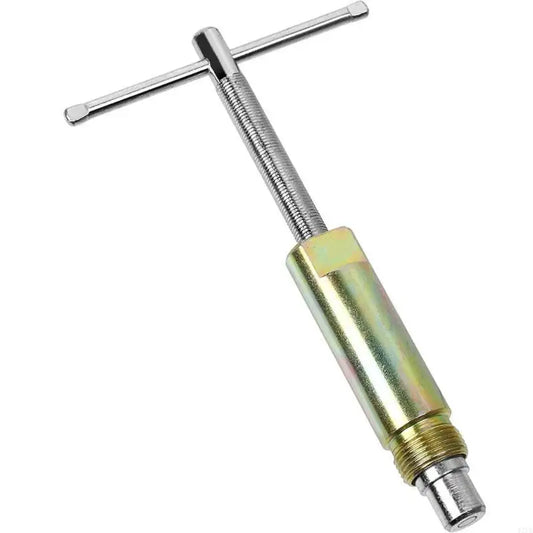
The old ferrule will not slide off. This pulls it.
A compression fitting works by squeezing a brass ring onto the copper. Once it has been tightened, that ring is swaged on — it will not come off over the end of the pipe, and neither will the nut behind it. So the usual answer is to cut the stub-out back, and then you are working with even less pipe than before. This tool seats inside the old fitting, takes the nut onto its own thread, and draws the whole lot straight off with a few turns of the T-handle.
Read this first: it is a 1/2 in tool, and it pulls, it does not cut.
This size fits the 1/2 in nominal compression fitting — the one on the inlet side of a standard angle stop, where the valve meets the copper coming out of the wall. It is not for the 3/8 in outlet that the faucet riser screws onto, and not for PEX, CPVC or flare fittings.
And the ring it pulls is scrap once it is off. That is normal — you fit a new nut and a new ferrule with the new valve. Nobody reuses a swaged ring.

No cutting
The stub-out keeps its length
1/2 in fittings
The inlet side of an angle stop
16.9 cm long
6.65 in, with a 4 in T-handle
Singles or packs
One, two or three
How it works
Four turns, not a hacksaw
1. Water off, valve opened to drain, old stop unscrewed and pulled clear — the nut and the ring stay behind on the copper. 2. Push the silver nose of the puller into the mouth of the pipe, right inside the old ferrule.
3. Run the old compression nut back onto the puller’s own threaded body, hand-tight against it. 4. Hold the body and turn the T-handle clockwise. The screw pushes against the pipe, the body pulls the nut, and the ring walks off the end. A few turns is all it takes.
What it saves
The inch of pipe you cannot get back
Cut the stub-out to get rid of a stuck ferrule and you lose length every time. On a pipe that came out of the wall short to begin with — behind a vanity, under a kitchen sink, against a finished tile wall — two of those cuts and there is nothing left to clamp a new fitting onto. Then it is opening the wall, or a coupling and a stub extension.
The escutcheon matters too. Cut back and the new stop sits deeper, so the trim plate no longer covers the hole. Pulling the ring leaves the pipe exactly where the plumber left it.
Old and seized
The ones that have been on twenty years
A valve that has never been turned tends to come with a nut welded in place by corrosion and hard water. Those are exactly the ones worth pulling rather than cutting, because they are usually in the worst position to get a saw into.
Be honest with yourself about the limit, though: if the nut will not even start onto the puller’s thread, or the screw is taking real force and nothing has moved, stop. Some fittings are past it, and a cut is the safe answer — better that than a kinked stub-out and a wet floor.
One, two or three
Most people need one
We will say that plainly: for a single valve, or the two under a bathroom sink, one puller is the whole job. Buy the single.
The 2 and 3 packs are for the cases where one is not enough — a plumber putting one in each van, a crew re-stopping a whole building, a landlord going through a block of units, or anyone who has learned that the way these tools die is a stripped thread on a nut that was never going to move. Then a spare in the box beats a second trip.
Straight answers
What it will not do
One size, and it is 1/2 in. There is no 3/8 in version in this listing, and 3/8 in is what most faucet and toilet risers use on the outlet side of the stop. Check which end you are working on before you order.
It does not save the ferrule. The ring comes off deformed and the nut is usually chewed. Buy a new nut and sleeve, or a new valve that ships with them — they cost almost nothing and a reused ring is a leak waiting for you.
It needs pipe to work with. The nose has to go into the end of the stub-out and the nut has to reach the puller’s thread. A pipe cut flush with the wall, or one that is bent, out of round or split at the end, gives it nothing to hold.
Copper, not plastic. A CPVC or PEX stub-out with a compression stop on it is a different job. So is a flare fitting, a sweated fitting and a push-fit — a push-fit comes off with a release clip, not a puller.
There is no published pulling force or steel spec. The maker gives none and we will not invent one. It is a zinc-plated steel body with a chromed T-bar; treat it as a hand tool, turn it by hand, and do not put a bar on the handle.
Before you start
Water off at the main, not just at the stop — the stop is the thing you have decided you do not trust. Open a low faucet to drain the line and keep a towel and a bowl under the work.
Support the pipe. Hold the stub-out steady with your other hand or a wrench while you turn. A stub-out that twists in the wall can break a soldered joint you cannot see, and that leak will be inside the wall.
Turn the water back on slowly and watch the joint for a few minutes, then check again an hour later. If your building needs a licensed plumber for this work, it still does.
The specifics
What you get
Fits
1/2 in nominal compression fittings on copper — the inlet side of a standard angle stop
Does not fit
3/8 in compression, flare, sweat, push-fit, PEX and CPVC
Length
16.89 cm (6.65 in) overall
T-handle
10.16 cm (4 in) across, sliding bar
Build
Zinc-plated steel body and screw, chromed T-bar, steel nose
Packs
One, two or three pullers — identical tool, just the count
Not included
Replacement nuts and ferrules, the new valve, and thread tape
Not published
A pulling-force rating, the steel grade and the thread spec — the maker gives none, so we quote none
Questions people ask
Before you order
Is my fitting 1/2 in or 3/8 in?
Look at which end you are fighting. The pipe coming out of the wall into the valve is almost always 1/2 in nominal copper — that is this tool. The small chrome or braided line running up to the faucet or toilet is 3/8 in, on the other end of the same valve. If you are pulling a ring off the wall pipe, you want 1/2 in.
Can I reuse the nut and ring?
No. The ring is deformed by design and the nut has been dragged over a thread it was never meant to meet. New nut, new sleeve — most new angle stops come with both.
Will it damage the copper?
Used as intended, no — that is the whole point of it. It goes wrong when the nose is not seated properly inside the pipe, or when the stub-out is left to twist while you turn. Seat it, hold the pipe, go steadily.
What if it will not budge?
Back it off and look. Often the nut is not square on the thread, or there is grit behind the ring. If the screw is taking serious force and nothing has moved, cut the pipe instead — forcing it risks the joint inside the wall, which is a much worse afternoon.
Does it work on a stub-out that is very short?
It needs enough pipe for the nose to go in and for the old nut to reach the puller’s thread. If the copper barely clears the escutcheon you may not have that, and a short stub is also the case where cutting hurts most — worth measuring first.
Why would I buy two or three?
You probably would not. One does a house. The packs are for trade buyers who want one in every van or on every job box, and for anyone re-stopping a building where a lost or stripped tool means a second trip.
Is a puller better than just cutting the pipe?
Where you have plenty of stub-out and easy access, cutting is quicker. Where the pipe is short, boxed in, tiled around or already cut once, pulling is the only way to keep the fitting where it is. That is when this earns its place in the bag.
Do I need any other tools?
An adjustable wrench for the old nut, a towel and a bowl, and the new valve with its nut and sleeve. Nothing else.
Shipping & returns
Delivery in 7–15 business days from the time you order — that window already includes the 1–2 business days we take to process. Tracking is emailed as soon as the carrier scans the parcel. Shipping & Delivery.
30-day returns. Items must be unused and in their original packaging. Email support@nexuratool.com to start a return.
Nexura Tools
Tools for repair, maintenance and the jobs in between — chosen for specs we can verify.