Stop breaking the tab
The connector comes off. The clip stays on.
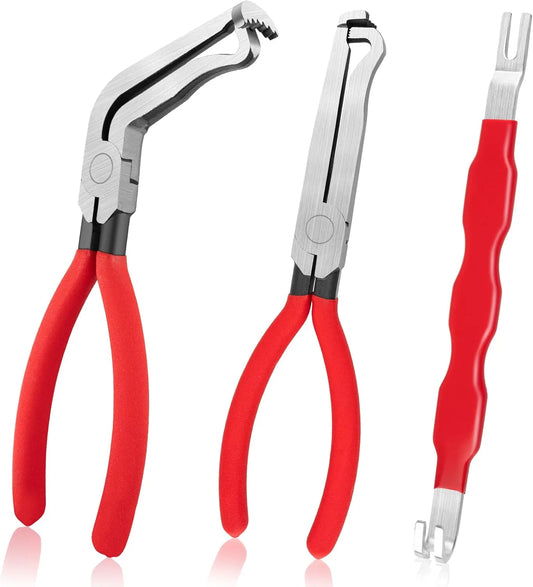
Every automotive plug has a small plastic tab holding it shut, and every one of them is somewhere your fingers do not fit. A screwdriver reaches it and snaps it. These three tools reach it and lift it — a hooked tip to pop the tab, a jaw to grip the plug body, and a pull that comes straight back instead of sideways.

How it actually works
Hook the tab first, then pull
The lower jaw ends in a thin hook. Slide it under the locking tab and lift — that is the step people skip, and it is why tabs break. Once the lock is clear, the serrated upper jaw grips the plug body and you draw it straight off the pin.
Both jaws work on the connector, never on the wire loom. Nothing gets levered against the sensor housing.
Three tools, three reaches
The angle is the whole point
They do the same job in different geometry. Which one you need depends entirely on where the connector is buried, which is why the set exists — but each is sold on its own if you already know the one you want.
Angled 60° pliers · 5.7 in
Short body, head kicked over 2.56 in. This is the one for a connector facing away from you, down beside the block or behind a bracket.
Straight pliers · 8.1 in
Long and slim, jaws in line with the handles. For plugs at the bottom of a gap where the only approach is straight down.
Release bar · 7.5 in
No jaws at all — a fork at each end, 0.39 in across. Slides between the plug halves and pushes them apart where no plier will fit.
If you are not sure which one
Take the set — it costs about a fifth less than the three bought separately
The three are not alternatives to each other. They are three different reaches, and which one a job needs is decided by where the connector sits — not by preference. Buy one and there is a fair chance the next plug you meet is the one it cannot get to.
The struck-through figure beside the price of the set is the real total of the three single options on this page. Add them up yourself — that is the whole argument.
The one people forget
The release bar is not a spare part
It looks like the throwaway item in the set and it is the one most mechanics reach for. Both ends are forks, so you work it in flat between the two halves of a plug and lever them apart — in gaps where a pair of pliers simply cannot open.
It is also the safest on brittle plastic: the load spreads across the fork instead of pinching on two points.
What the pliers are made of
Serrated jaw, return spring, dipped grip
The jaws are cut with fine serrations so a rounded plug body does not slip out under a hard pull, and the manufacturer specifies high-carbon steel for the forged parts — no hardness figure is published, so we are not printing one.
A coil spring between the handles springs them open again, which matters when one hand is holding the plug and the other is doing everything else. The grips are dipped rather than moulded — less comfortable than a proper bi-material handle, and honest to say so.
Before you buy
Three things we would rather you knew now
These are for plastic connectors, not for gripping metal. The manufacturer’s own spec sheet says “suitable for: non-metal”. The jaws are shaped and serrated for plug housings. Use them as general pliers on a nut or a bolt and you will spring the jaws.
No connector will come apart if you have not released the lock. That is true of every tool ever made for this job. Find the tab, lift it, then pull. If a plug resists after the lock is clear, it is corroded — more force breaks it.
Unbranded, and sold as such. There is no brand behind these, no torque or hardness rating published, and no manufacturer warranty. What stands behind them is our own 30-day return window.
Where they come out
Anything that plugs in under a bonnet
-
Ignition coils and spark plug packs — the classic buried connector on a plug change.
-
Fuel injectors — tight, hot, and the tabs go brittle with age.
-
Air flow and oxygen sensors — usually facing the wrong way, which is what the 60° head is for.
-
Headlights and indicators — a bulb change that would otherwise mean taking the whole housing out.
-
Any loom on a bike, van or ride-on mower — the plugs are the same design everywhere.

Measurements
The specifics
| Angled pliers |
5.71 in overall · head offset 2.56 in · 60° bend |
| Straight pliers |
8.07 in overall |
| Release bar |
7.48 in overall · fork opening 0.39 in, both ends |
| Material |
High-carbon steel as stated by the manufacturer. No hardness rating published. |
| Jaws |
Serrated upper, hooked lower, coil return spring |
| Handles |
Dipped non-slip coating |
| Intended for |
Plastic automotive connectors. The maker lists it as “non-metal” use. |
| In the box |
Whichever option you pick above, and nothing else — no case, no printed manual |
Good to know
Questions people ask
Which one should I buy if I only want one?
The angled 60° pliers. Most of the connectors that defeat fingers are ones facing away from you, and the offset head is what gets round them. If your problem is specifically a plug in a deep narrow gap, take the straight pair instead.
Will these fit my car?
They are not vehicle-specific. Automotive connectors follow a handful of common patterns across nearly every make, and these are shaped for those patterns rather than for one brand’s plugs.
Can I use them on a live circuit?
Do not. These are bare steel with a dipped grip, not insulated VDE tools, and nothing about them is rated for live work. Disconnect the battery before you go near the loom — that is good practice regardless of tooling.
Will the serrations mark the plastic?
They can leave light witness marks on a soft housing if you squeeze hard. That is the trade for not slipping. Grip firmly enough to hold and let the pull do the work, rather than crushing the plug.
Is the release bar any use on interior trim?
People do use forked bars like this for panel clips, and it will work in a pinch. It is steel with a fairly sharp fork, so on a visible trim panel a proper plastic trim tool is kinder to the finish.
Shipping & returns
Delivery in 7–15 business days from the time you order — that window already includes the 1–2 business days we take to process. Tracking is emailed as soon as the carrier scans the parcel. Shipping & Delivery.
30-day returns. Items must be unused and in their original packaging. Email support@nexuratool.com to start a return.
Nexura Tools
Tools, home gear and gadgets — chosen for specs we can verify.