
Measuring up a room
Floor to ceiling, wall to wall, and the diagonal nobody can hold a tape across on their own. Press once for a length, switch to area and it multiplies two readings together without you writing either of them down.


Pocket size · 30 m range · Eight modes
An aluminum laser measure about the length of your thumb. It reads from 1.2 inches out to 98 feet in meters, inches or feet, and works out an area, a volume or a height without you writing anything down. Read this first: it fires a visible red laser rated under 1 mW, and the maker's own two documents disagree about the laser class. We treat it as the stricter of the two — do not look into the beam, and do not point it at anyone's eyes.
A 2-pack is two separate meters, each with its own charging cable and lanyard. The supplier does not build a twin pack, so the two are picked and shipped as two singles and may arrive on different days.
Turn it over
Drag to turn the model. The display and the three buttons sit on one face, the laser lens and its window are in the top end you point at the wall, and the charging slot is in the bottom end. The back and sides are plain brushed aluminium.
This is a 3D model we built to the maker's published dimensions — 56 × 21.5 × 13.5 mm — not a photograph of the item. The photographs in the gallery are the maker's own.
Tape measure, minus the tape
Twenty-five grams of aluminum, about the length of your thumb. Put the red dot on the far wall, press once, read the number. It reaches 98 feet, switches between meters, inches and feet, and does the area and volume arithmetic for you.


Three controls
The front of it is a screen and three controls, and that is the whole interface. The round button takes the measurement — the maker's own label for it is “one press to use”. The small switch beside it is marked F/R. The third button turns the meter off. Everything this thing can do, from a single length to a two-sided Pythagoras, comes out of those.
Hold the body against your starting point, put the dot where the measurement should end, and press. The reading lands on the screen a moment later.
Single, continuous, area, volume, wall area, one-side Pythagoras, two-side Pythagoras and height — the eight printed on the maker's own diagram, and the eight this page will claim.
About 1.2 inches at the close end and 98 feet at the far one, read in meters, inches or feet. The maker lists all three units and never says how you switch between them.
The maker prints “F/R function switch” on its own diagram and never says what the letters stand for, so neither do we.
The specifics
Two of this maker's own numbers contradict each other, and one of its graphics advertises a part this model does not have. Rather than quietly pick the flattering version, the table below prints both figures and names the gap.
maximum range
About 98 ft. The close end is 0.03 m, roughly 1.2 in.
accuracy, cautious figure
Its spec block says 0.002 m, its body text 0.001 m. We quote the larger.
on the maker's graphic
About 0.9 oz. An older supplier title said 24 g; the artwork says 25.
measuring modes
Length, continuous, area, volume, wall area, height, two Pythagoras.
end to end
About 2.2 in. Its own drawing rounds the other sides to 22 and 13 mm.
built-in cell
Lithium, charged over USB. No charge time or runtime is published.
* Marked figures are the maker's own and are not measured by us.

An aluminum-bodied laser distance meter with a 30 m range, eight measuring modes and a built-in rechargeable cell. No test report is published for it, and this model has no angle sensor.
The maker's own packing graphic names the cable and the lanyard; the cell is built in and already fitted. No case, no pouch and no printed manual appears in any of its pictures.

Inside the case
The screen and the two front buttons lift off the aluminium shell. Behind them sit the board, the optics block that fires the beam and reads it coming back, and the battery. Drag to turn it while it moves.
The maker's diagram below names the parts it says are inside: a First Sensor silicon photomultiplier, an ST microcontroller, a TDK inductor and capacitor, and a Silicon Labs clock chip. Those are the maker's claims, not ours — we have not opened a unit to check them. The moving model is our own illustration of how the pieces stack, built to the published outside dimensions, not a photograph of a teardown.

Where it earns its keep
Everything below is work this meter is actually sized for: indoor distances, measured on your own, where the answer has to be good to a couple of millimeters rather than certified. The last card is the one to read twice.
Floor to ceiling, wall to wall, and the diagonal nobody can hold a tape across on their own. Press once for a length, switch to area and it multiplies two readings together without you writing either of them down.
Wall area for paint and paper, volume for concrete, insulation or air. The arithmetic happens where you are standing, so you are not carrying three numbers out to the truck and multiplying them from memory.
56 mm long, 25 g, with a lanyard loop at one end. It lives in a coat you already wear, which is the whole difference between having a measure with you and having one in the toolbox at home.
Outdoors at long range, and anywhere a number gets signed off. It stops at 30 m, the maker's two accuracy figures disagree with each other, and this model has no angle sensor — its own graphic says so. It also fires a visible laser, so keep the dot on the wall and off people's eyes.
Living with it
A 200 mAh cell is built in and a charging cable comes with it. The maker publishes no charge time and no runtime, so the honest advice is to top it up when you think of it rather than plan a day around a figure nobody has given us.
The measure button and the switch marked F/R step through the eight modes: a single length, a running readout as you walk, an area, a volume, a wall area, a height, and the two Pythagoras calculations for a span you cannot stand square to.
Put the body against your starting point, the red dot where the reading should end, and press once. The maker never says which end of the body a measurement starts from, so if a job has to be exact, check it once against a tape and remember the offset.
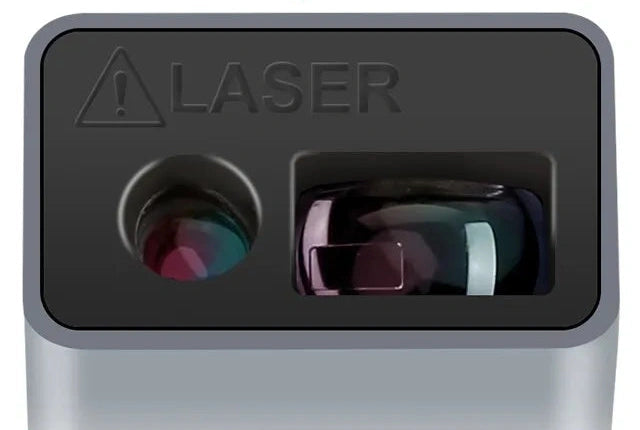
That is the whole routine. The one habit worth forming is where the dot goes: behind that panel is a laser whose class the maker's own two documents cannot agree on, under a warning triangle it molded into the case itself. Keep the beam on the wall, never on a face, and never on a mirror pointed at one.
Compared with the usual options
Three ways to get a number off a wall. The rows that matter most are near the bottom: what each one can tell you about its own accuracy, and the two jobs this little one will not do.
| Feature | Nexura pocket laser | A steel tape measure | A full-size laser meter |
|---|---|---|---|
| Measure a long span on your own | Not past arm's reach | ||
| Reaches 30 m | Only as far as the tape | Usually further | |
| Works out an area or a volume | |||
| Pythagoras for a span you cannot reach | Depends on the model | ||
| Works round a corner or without line of sight | |||
| Fits on a key ring | Depends on the tape | ||
| Works with a flat battery | |||
| A published accuracy figure | Two, and they disagree | Depends on the tape | Usually one, with conditions |
| An angle or tilt reading | Depends on the model |
Compared by type, not by brand. “Depends on the model” means it varies with the one you buy. Nothing in this table is an accuracy rating; this meter has no published test report behind either of its figures.
Free shipping on orders of $49 or more. Below that, standard shipping is a flat $4.95 to any of the 50 US states. Delivery takes 7–15 business days from the time you order, and that window already includes the 1–2 business days we take to process. Shipping & Delivery.
30-day returns. Items must be unused and in their original packaging. Email support@nexuratool.com with your order number to start a return. Returns & Refunds.
30 days from delivery. Email support@nexuratool.com with your order number and what you want to return. We reply with a return address — do not send anything back before you have it, or we cannot match the parcel to your order.
What we can take back: unused items in their original, undamaged packaging. Adhesives, sealants and lubricants cannot be returned once opened; the same goes for any item with a broken safety seal. That is a safety and hazardous-goods rule, not a preference.
Who pays: return shipping is paid by you, except when the item arrived damaged, faulty or was not what you ordered — then we cover it and refund the original shipping too.
Refunds go back to the original payment method within 5 business days of the return reaching us. Full returns policy.
QUESTIONS PEOPLE ASK
30 m · Eight modes · 25 g
One meter or two, each with a charging cable and a lanyard. It fires a visible red laser under 1 mW, so keep the dot on the wall and off people's eyes. Free US shipping from $49, and 30 days to return unused items.