Too small to call anyone about
The hole is the size of a nail. The quote will not be.
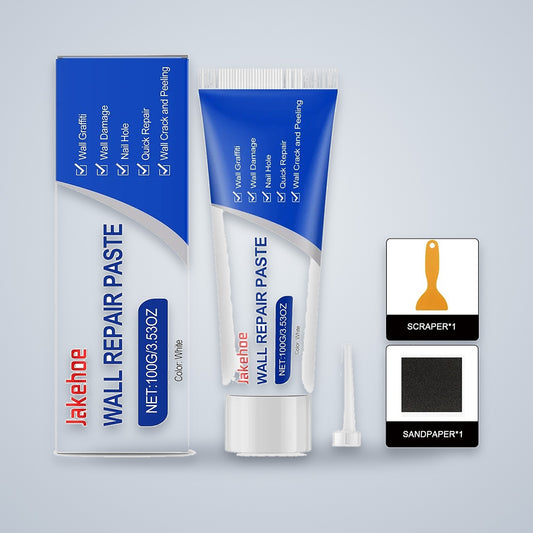
A picture hook pulled out of the plaster. The scuff behind a door handle. The hairline crack that reopens above a window every summer. None of it is worth a tradesman's call-out, and all of it is what a landlord photographs on the way out. This is a 100 g tube of ready-mixed white filler with the scraper and the sandpaper already in the box — squeeze, pull it flat, sand it back.

100 g in the tube
132 g boxed, tube about 16.5 cm
Scraper and sandpaper in the box
Nothing else to buy for a small patch
Ready mixed, water based
No mixing, no solvent smell, rinses off
3-year shelf life
Cap it, keep it cool and dry
What it is for
Five marks, one tube
Nail and screw holes. Hairline cracks in plaster. Chips where a door frame or a skirting board has been knocked. Flaking patches where old paint has lifted. Crayon and scuff marks that keep reading through a fresh coat of emulsion.
The filler is opaque enough to bury a dark mark rather than let it ghost through, which is why it gets used on a child's wall as often as on cracks.
The part nobody tells you
The sandpaper is used twice, not once
Most people squeeze filler into a hole, wipe it with a finger and wonder why the patch shows under a lamp. The square of sandpaper in the box is there for both ends of the job. First to knock the lifted paint and the crumbling edge off the damage, so the filler meets sound wall instead of dust. Then again once it is dry, to take the proud fill back level with the surface around it.
The scraper does the middle part. Pull it across the hole in one pass at a low angle and let the blade bridge the damage, rather than pushing the paste in with the tip. Leave the fill slightly proud — a millimetre is plenty. Filler sinks a little as the water leaves, and it is far easier to sand a high patch flat than to fill a dished one twice.
Deep damage wants two thin passes with a dry interval between them, not one thick one. A thick fill skins over, stays soft underneath and cracks along the middle a week later.
Two options
One tube, or one for each end of the house
A single 100 g tube covers a flat's worth of nail holes with paste left over. The second set is for the jobs where you are walking room to room — an end-of-tenancy tidy, a whole-house repaint, or simply keeping one in the van and one under the sink.

1 set
One 100 g tube with its nozzle, one scraper, one square of sandpaper. Enough for the hooks, hairline cracks and knocks in an average flat.

2 sets
Two complete kits. For a whole-house repaint, a move-out clean, or keeping a spare where the damage happens rather than where the toolbox lives.
Straight answers
Three things we would rather you knew now
It dries white, not your white. On brilliant white plaster a filled nail hole disappears. On a colour, on a yellowed ceiling or on a wall with any sheen, the patch will read until you touch it in with your own paint. Plan the touch-up as part of the job.
Small damage only. Nail holes, chips, hairline cracks, scuffs. Anything bigger than a coin has no wall behind it to hold the filler, and wants a backing patch and mesh tape first — no tube of paste substitutes for that.
Fix the damp before you fill it. The pack describes the cured filler as mould resistant, and that is all it means. If a patch is flaking because water is getting in, filler over the top will lift again in a month. Find the leak, let the wall dry, then repair.
The specifics
Sizes and materials
Net content
100 g (3.53 oz) per tube
Packed weight
132 g, tube about 16.5 cm long
In the box
Tube, fine nozzle, moulded scraper, one square of sandpaper — per set
Base
Water based — calcium carbonate body, vinyl acetate–ethylene emulsion for adhesion, calcium oxide to drive the cure, hydroxypropyl methylcellulose to keep it spreadable
Surfaces
Interior plasterboard, plaster, cement render and painted walls
Shelf life
3 years capped, stored cool and dry
Not for
Holes larger than a coin, movement joints, or walls that are still damp
Questions people ask
Before you order
Can I paint over it?
Yes, once it is dry and sanded. It is a water-based filler, so emulsion takes to it without a fight. For a patch bigger than a coin, spot-prime it first — bare filler is more absorbent than the paint around it, and without primer the repair can flash back as a dull patch in the finished coat.
How long does it take to dry?
The pack says quick-drying and gives no figure, so we will not invent one. In practice a skim over a nail hole in a warm room is sandable in well under an hour; a deep fill is an overnight job. Judge it by the wall, not the clock — it is ready when the fill has gone uniformly white and feels hard, not cool and rubbery.
Will it match my white wall?
It dries a plain white. On brilliant white plaster a small hole vanishes. On anything aged, coloured or with a sheen, treat the fill as the first half of the repair and touch in with your own paint for the second.
How big a hole will it fill?
Nail and screw holes, chips, knocks and hairline cracks — up to roughly the size of a coin. Beyond that there is nothing behind the hole to hold the paste, and you need a backing patch and mesh tape before any filler goes near it.
Can I use it in a bathroom or kitchen?
On the walls, yes — it is a normal interior filler and the cured paste is described as mould resistant. What it cannot do is out-argue water: if the damage is there because a seal or a pipe is leaking, fix that and let the wall dry first, or the repair lifts again.
Which surfaces does it stick to?
Interior plasterboard, plaster, cement render and painted walls. It is not made for exterior weather exposure, for joints that move, or for bare timber that will shrink and swell with the seasons.
Does it shrink or crack?
A thin fill barely moves. A deep one sinks as the water leaves, which is why the instruction is two thin passes rather than one thick one, and why you leave the first pass slightly proud and sand it back.
One set or two?
One if you are fixing what you can see today. Two if you are repainting, moving out, or would rather have a tube where the damage happens than walk back to the toolbox.
Shipping & returns
Delivery in 7–15 business days from the time you order — that window already includes the 1–2 business days we take to process. Tracking is emailed as soon as the carrier scans the parcel. Shipping & Delivery.
30-day returns. Items must be unused and in their original packaging. Email support@nexuratool.com to start a return.
Nexura Tools
Tools for repair, maintenance and the jobs in between — chosen for specs we can verify.